Deadheading Dahlias: Where to Cut for More Blooms All Season
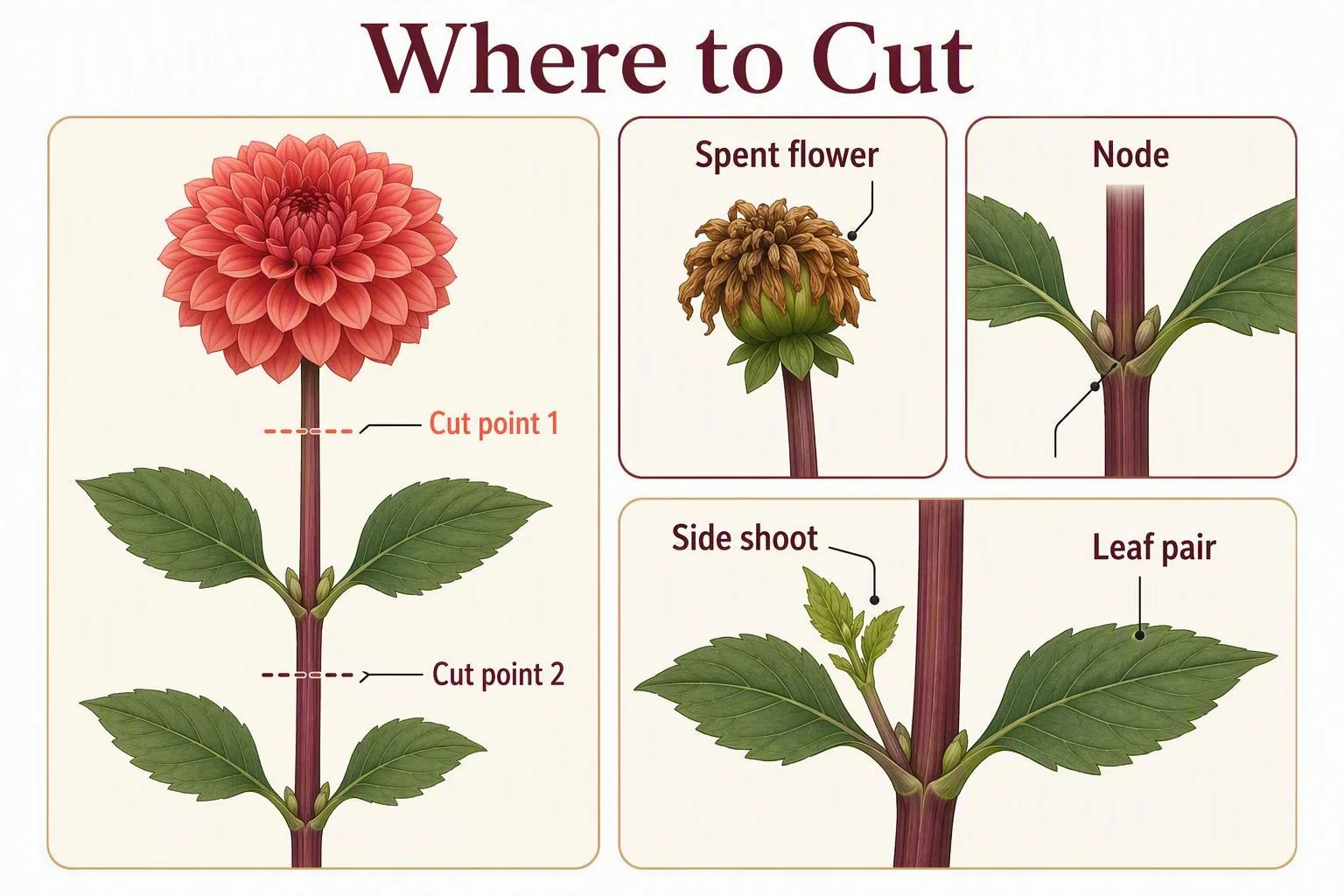
One short petal snip can leave a dahlia carrying the very structure that tells it flowering is finished. For deadheading dahlias, remove the whole spent flower stem and cut back to a strong side shoot, leaf pair, or clearly visible bud. In many plants, that means cutting roughly 10–20 cm below the flower, depending on the cultivar and the next useful branching point.
The practical test is simple: if the flower is fading, brown-edged, rain-battered, or developing a dull, concave centre, follow its stem down until you find living growth. A few seconds spent identifying that junction saves the more common mistake: leaving a long, leafless stem that produces no attractive replacement bloom.
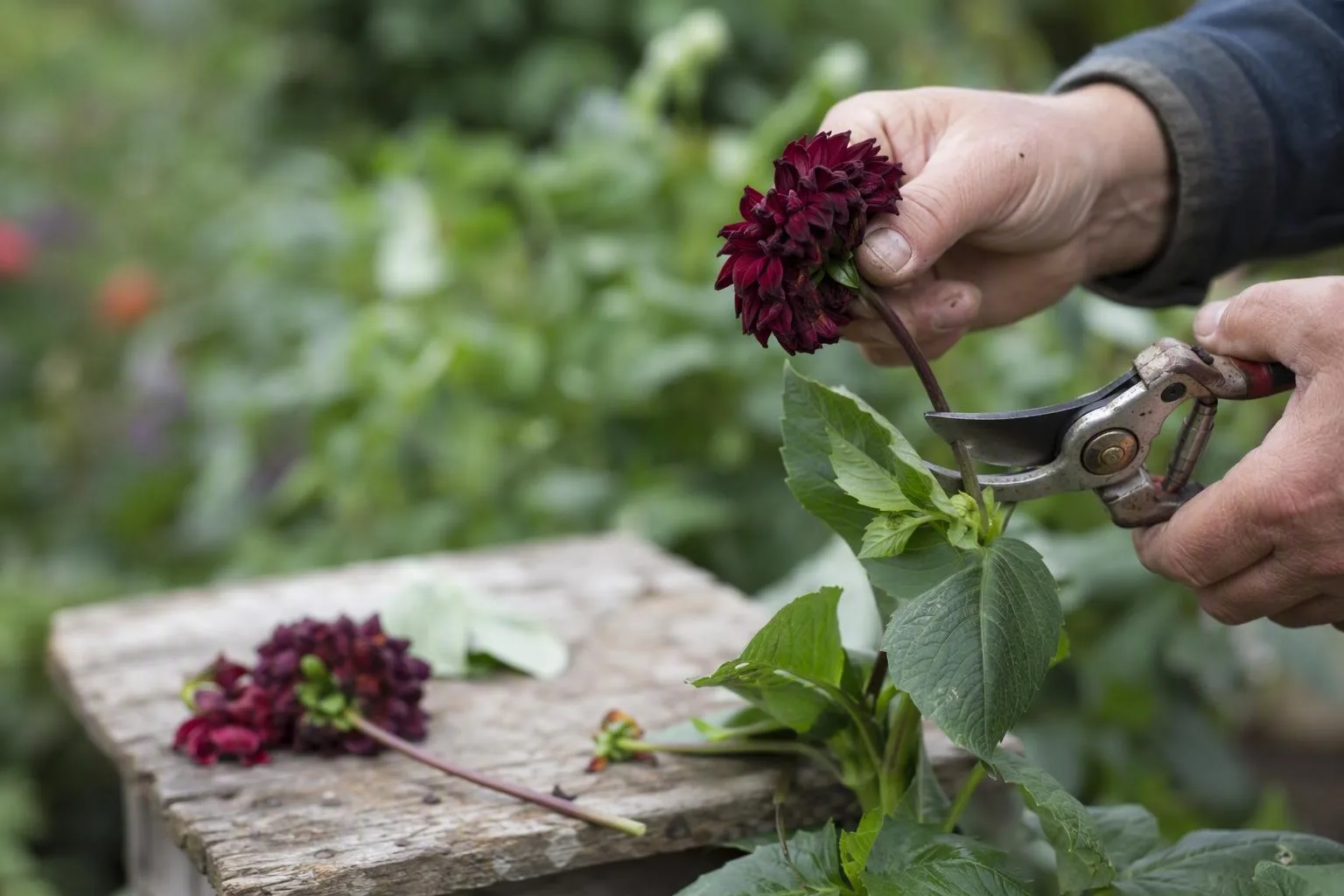
The cut that keeps a dahlia flowering
Take clean, sharp secateurs and remove the old flower, its flower stalk, and the bare section below it. Stop above a healthy side shoot, a useful pair of leaves, or a firm developing bud. Don’t simply pinch off the petals or cut immediately beneath the flower head; that leaves much of the old flowering stem in place.
The seasonal payoff is not magic, and it isn’t that one cut forces a dahlia to bloom on command. The useful change is that the plant is no longer carrying a finished flower structure while nearby shoots continue their own development. Repeated removal keeps the plant’s display from filling with brown heads and gives new stems room to emerge visibly.
There is a trade-off. A cut made too high leaves an ugly stub. A cut made deep into the main stem removes productive growth you may need later. The best place is the highest healthy junction that leaves a strong route for the next flower.
Read the stem before you reach for pruners
Deadheading starts with identification, not cutting. A spent dahlia flower usually has fading or collapsing ray florets, brown edges, and a centre that looks open, dull, or slightly concave. After rain, the petals may hang together in a soft, heavy mass. That is different from a young bud, which is generally rounded, firm, and closed over the centre.
Look at the structure below the flower as well. A developing side shoot may carry a small pointed leaf pair or a rounded bud at its tip. A flower that is merely not fully open still has petals held tightly around a raised centre; removing it wastes a future bloom. If you’re unsure, leave it for another inspection rather than making a speculative cut.
In warm weather, the distinction becomes easier with practice because the same plant shows the progression repeatedly: tight rounded bud, opening flower, full flower, then a softer head with a collapsing centre. Inspecting one stem at a time is more reliable than scanning the bed from a distance.
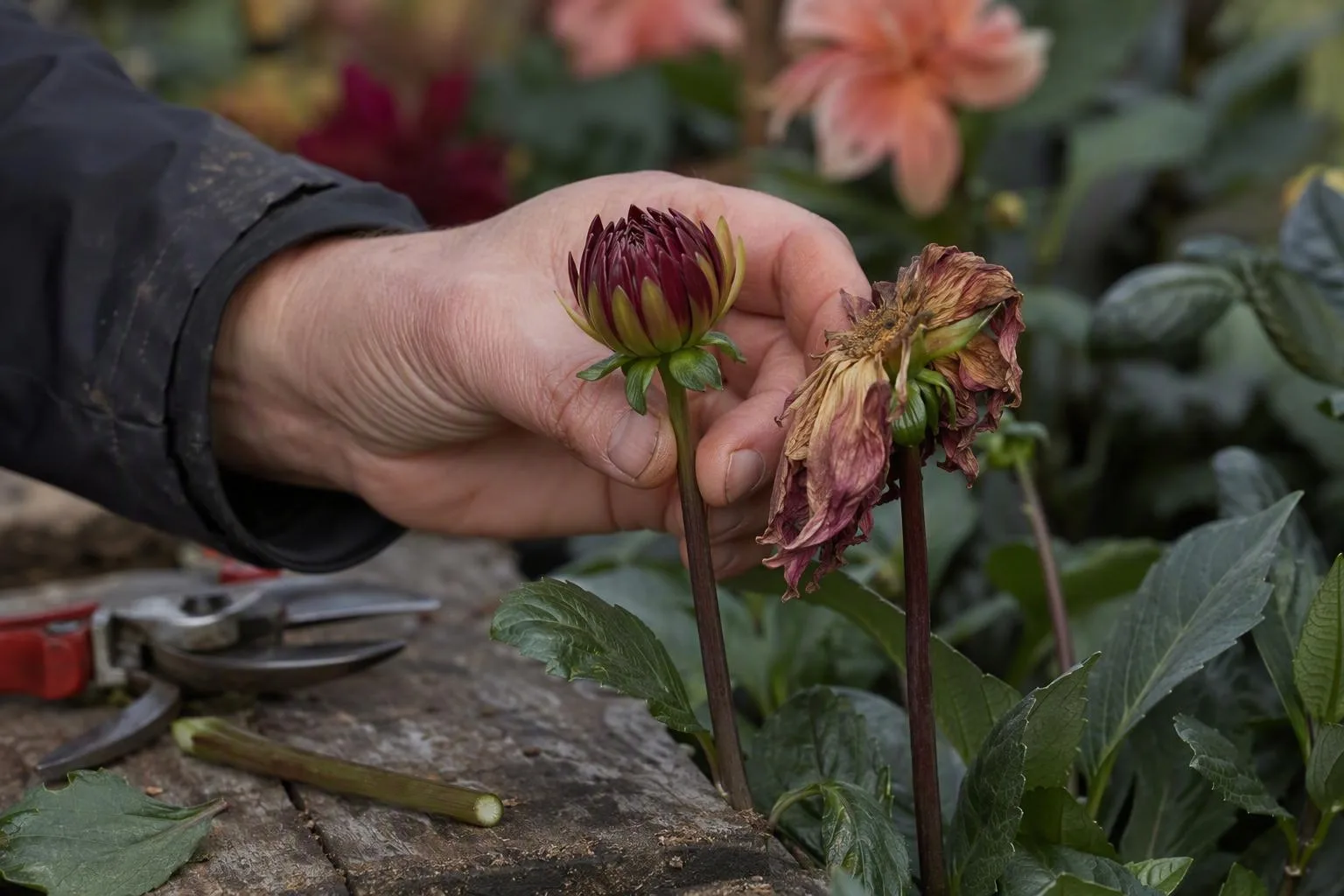
At the node: the anatomy of a useful deadhead
The visible flower is only the end of a stem system. Leaves and side shoots join the stem at nodes, and those junctions contain dormant or developing buds. When you remove a finished flower above a healthy node, you preserve that node’s route to light while removing the old terminal structure.
Think of three cuts:
- Petal-only snip: the head looks tidier for a moment, but the stalk and spent reproductive structure remain.
- Cut just below the bloom: the old head is gone, but a long bare stem may remain with no useful growth point.
- Cut back to a branching point: the stem ends at living growth, giving the next shoot a clear place to continue.
The third option is usually the soundest. It doesn’t guarantee a new bloom at that exact node: the shoot may be weak, shaded, damaged, or still too young. It does, however, align the cut with the plant’s existing architecture instead of treating the stem as a disposable stick.
Where the next healthy node sits varies. On a compact bedding dahlia it may be close to the flower. On a tall decorative cultivar, the useful junction may be 10–20 cm lower. That range is a working judgement, not a botanical law: choose the node by the condition of the growth, not by measuring every stem.
A seven-day deadheading routine for continuous color
A rigid calendar is less useful than a short inspection loop. During warm, bright weather, walk the plants at least twice in a seven-day period. After heavy rain or a spell of heat, inspect sooner. Flowers can move from attractive to damaged while the rest of the bed still looks fresh.
- Start at one end of the row and check every flower head.
- Leave rounded, firm buds and flowers whose petals are still upright and fresh.
- Remove heads with browning petals, a collapsing centre, or rain damage.
- Trace each stem down to the highest strong side shoot or healthy leaf junction.
- Make one clean cut, then remove the fallen material from dense foliage.
Don’t wait until every petal has dropped. A rain-soaked flower can remain attached while becoming a snag for nearby stems and a poor focal point. Equally, don’t deadhead by appearance alone: a brown outer petal on an otherwise firm, open flower may call for another day rather than immediate removal.
Use the first cut to shape the next flush
Deadheading can become light structural pruning when a stem has already finished its useful display. If the first healthy side shoot is close to the flower and points into open space, cut back to it. The next stem then develops from a location that is visible, supported, and less likely to collide with neighbouring growth.
A lower cut is justified when the upper section is weak, bare, broken, diseased-looking, or so crowded that another flower would be buried. In that situation, preserving height is not the same as preserving productivity. A shorter stem with healthy leaves and room around it may contribute more to the next flush than a tall stem carrying a single exhausted branch.
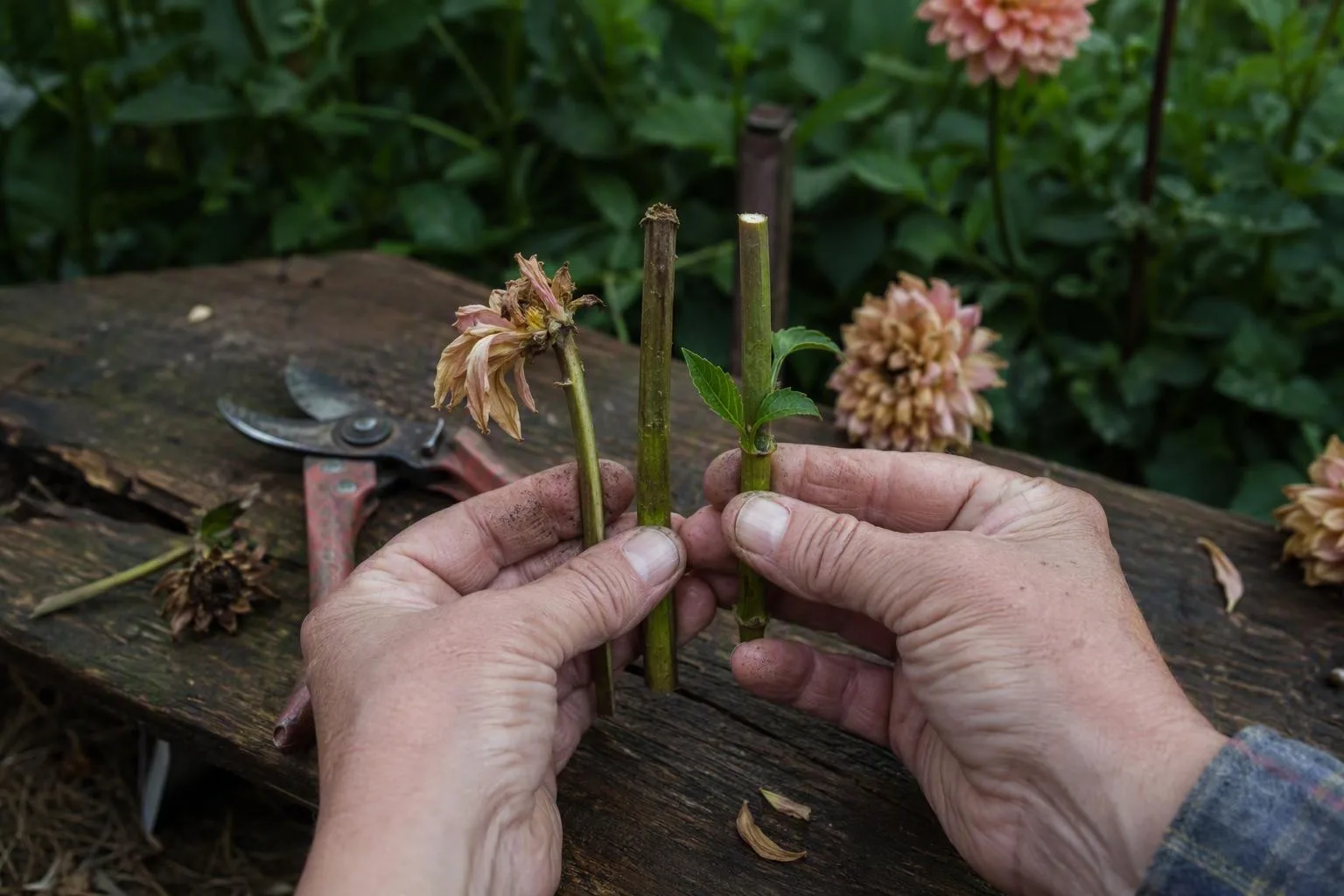
Make the cut with sharp blades rather than crushing the stem. Dahlia stems are often hollow, which is part of why a crushing cut can do more damage than expected: it leaves a ragged, split end instead of a small clean wound. A slight angle is sometimes recommended to help rain run away from the cut surface, but growers disagree about how much this matters. A clean cut through sound tissue is the priority; don’t create a long sloping wound in pursuit of drainage.
Deadheading is not the same as cutting flowers
Harvesting a dahlia for a vase and deadheading it use the same basic principle, but the decisions differ. For a bouquet, you want a usable stem length and a flower at a suitable opening stage. For deadheading, you want to remove the spent head while keeping enough healthy plant structure to support the next shoot.
A clean bouquet cut can replace deadheading on that stem because the old flower and its stalk leave the plant together. The cut still needs to land above a strong branching point rather than at an arbitrary height. If the stem is too short to harvest attractively, deadhead it for the plant’s shape instead.
For a longer-lasting arrangement, dahlia harvest timing and conditioning deserve their own treatment; see How to Cut Dahlias for Longer-Lasting Vase Flowers. The practical distinction is worth remembering: cutting flowers is a harvest decision, while deadheading is a plant-management decision.
What not to cut: foliage, buds, and productive stems
Healthy leaves are working surfaces, not clutter. They supply carbohydrates for active growth and help the plant continue building reserves below ground. Removing a large amount of sound foliage simply because the bed looks untidy can reduce the plant’s capacity to support later stems.
Leave unopened buds, sturdy side shoots, and green stems carrying future flowers. Also leave a useful leaf pair below a deadhead when the alternative is cutting down into a bare section. The exception is damaged tissue: a broken, blackened, collapsed, or suspiciously soft section should not be retained merely to preserve height.
This is where over-pruning starts. One spent bloom becomes a low side shoot; the next cut removes another leaf pair; soon the plant is neat but carrying fewer active growing points. Deadheading should reduce completed flower structures, not strip the plant to a collection of stems.
Three deadheading mistakes that quietly reduce the display
1. Snipping off petals only
This is the cosmetic fix. The brown colour disappears, but the stem still terminates in the old flower structure. Follow the stalk down and make the cut where green growth can take over.
2. Cutting below every visible bud
A rounded bud is an investment already made by the plant. Removing it because it sits near a spent flower reduces the next flowering opportunity. Separate the old head’s stem from the bud’s stem before cutting; they may divide at the same node.
3. Leaving long, crushed stubs
Long stubs bend, snag neighbouring stems, and make the plant harder to inspect. Because dahlia stems are often hollow, blunt blades can crush rather than slice them. Clean the blades before moving from a suspect stem to healthy growth. If a flower or stem looks diseased or rotten, place the removed material in household waste rather than home compost.
That disposal choice is a precaution, not a diagnosis. Home compost piles vary in heat, moisture, and maturity, so material showing active rot is a poor candidate for a small cool heap.
When deadheading fails, diagnose the plant before cutting harder
If a dahlia still flowers poorly after spent heads are removed, more severe pruning is unlikely to solve the underlying problem. Start with the plant’s overall pattern.
- Long, thin stems with few flowers: check light and crowding before cutting. A plant reaching toward brighter conditions may need a location or spacing correction.
- Large green growth with few flowers: review feeding, especially repeated high-nitrogen applications. Extra leafy growth does not automatically become extra blooms.
- Small flowers, limp leaves, or buds that abort: check the root zone for drought stress, particularly in containers and raised beds that drain quickly.
- Tattered petals or distorted buds: inspect for pest feeding before blaming the deadheading cut.
- Healthy plants with different flowering habits: allow for cultivar differences. Some dahlias branch freely; others make a smaller number of large flowers on taller stems.
Deadheading removes finished flowers. It cannot replace adequate light, steady moisture, sensible feeding, or enough room for the plant’s natural branching pattern. If the whole plant is weak, read the roots, leaves, and stems before taking another cut. The late-summer flowering problem may need a broader diagnosis; compare the symptoms with Why Dahlias Stop Blooming in Late Summer.
The late-season decision: keep removing flowers or let one set seed
Before frost, continue removing spent heads if you want the plant to direct its remaining season toward flowers. The value of each cut depends on how much warm growing weather remains and whether the plant still has healthy leaves and active buds. A dahlia already slowed by cold, drought, or disease may not repay aggressive trimming.
Leaving one selected flower to mature can make sense if you want to collect seed for an experiment. Seed-grown dahlias are not expected to reproduce a named parent cultivar reliably because the seedlings carry a new genetic combination. Keep the selected head separate from routine deadheading and label it; otherwise it is easy to collect a dry head without knowing which plant produced it.
For most gardeners, the late-season choice is straightforward: keep cutting while flowers and foliage are still productive, then stop treating the plant as a summer display once frost preparation becomes the priority. The next decision is whether you’re leaving the plant to finish flowering or moving on to How to Lift and Store Dahlia Tubers Before Frost.
Questions that come up at the snipping stage
Can you deadhead dahlias growing in containers?
Yes. Use the same node-level cut, but inspect container plants more often. A limited root volume can magnify drought and nutrient stress, and deadheading won’t compensate for a dry root ball or weak light.
Should you deadhead dahlias before the flower is completely finished?
Remove a bloom once its petals are fading, browned, rain-damaged, or its centre is collapsing. Don’t remove a rounded, firm bud merely because it hasn’t opened yet.
Can regular cutting for bouquets replace deadheading?
Often, yes. Harvesting a usable stem removes the spent flower and its stem at once. Make the cut above a strong branching point, then remove unattractive spent blooms that remain on the plant.
Save this rule for the next inspection: follow the old flower down, find living growth, and cut above it. The exact height changes from stem to stem; the decision does not.
Frequently Asked Questions
Can you deadhead dahlias growing in containers?
Yes. Use the same node-level cut, but inspect container plants more often because limited root volume can magnify drought and nutrient stress; deadheading will not compensate for a dry root ball or weak light.
Should you deadhead dahlias before the flower is completely finished?
Remove blooms once petals are fading, browned, rain-damaged, or the center is collapsing. Do not remove a rounded, firm bud merely because it has not opened yet.
Can regular cutting for bouquets replace deadheading dahlias?
Often, yes: harvesting a usable stem removes the spent flower and its stem at once. Make the cut above a strong branching point and continue removing unattractive spent blooms that remain on the plant.