Deadheading Peonies: Where to Cut and When to Stop
Cut a spent peony flower back to the first healthy set of leaves, not to the ground. The finished stem should still carry a green leaf pair, while the faded petals and swelling seed pod are gone; that single distinction is what separates useful deadheading from premature summer pruning.
Deadheading peonies is worth doing for a cleaner plant and to stop the flower head developing seeds, but it will not make a normal herbaceous peony rebloom. Keep the foliage working through summer, then treat autumn leaf removal as a separate job.
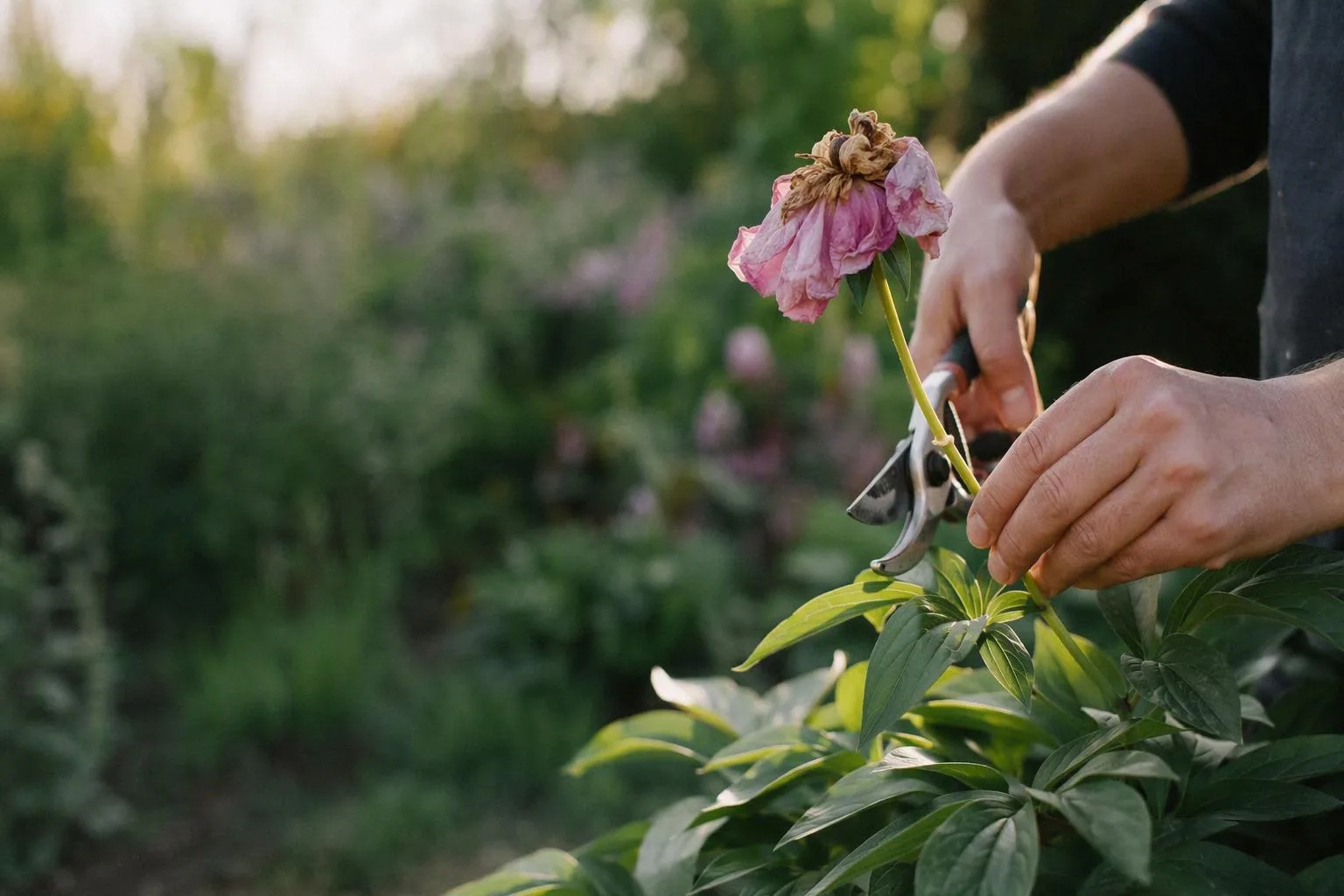
Make the cut as soon as the flower is spent—but leave the leaves
Start when the petals have fallen, browned, or collapsed enough that the flower is no longer contributing to the display. You do not need to cut every flower the minute one petal drops. A cluster can be dealt with together once most of its blooms are finished, provided the stems are still easy to identify.
Trace the flower stem downward with your fingers. Find the first healthy leaf set below the flower, then cut the stem just above that set. A clean cut slightly above the node leaves the leaf pair attached and removes the spent head, the developing ovary, and the short length of bare stalk between them.
- Use sharp secateurs rather than pulling the flower head off.
- Follow each flower stem down instead of cutting across the whole clump at one height.
- Choose the first sound leaf set, unless it is badly spotted, torn, or too weak to support the remaining stem.
- Make the cut a little above the node, angled enough that water does not sit on the cut surface.
- Remove the detached flower and any seed pod from the canopy.
The angle matters less than the location. A perfectly angled cut in the wrong place is still the wrong cut. Leaving a long, leafless stub looks untidy and can die back; cutting below all the leaves removes photosynthetic surface the plant still needs.
Clean tools are particularly useful when foliage is already marked. Wipe soil and plant residue from the blades between visibly affected plants, and avoid handling wet leaves. This is not a ritual that makes every fungal problem disappear, but it reduces the chance of carrying contaminated sap and debris from one clump to another.
Deadheading changes the flower display, not the plant's basic flowering schedule. Once the bloom has opened, removing it cannot redirect that same stem into another normal flower. The practical payoff is a tidier clump and less opportunity for seed development, not a guaranteed second flush.
The node-level decision: which leaf set should receive the cut?
“Cut to the first leaves” is a useful starting rule, not a command to preserve a damaged leaf pair. Inspect the stem below the flower.
- First leaf pair healthy: cut just above it.
- First leaf pair spotted or collapsed: move down to the next healthy set, keeping as much sound foliage as possible.
- Long bare section above a strong lower set: cut to the stronger set rather than leaving an ornamental twig.
- Seed pod already swelling: remove the pod with the flower stem; there is no benefit in preserving a pod merely because it has formed.
A peony leaf is not decorative filler after flowering. Its blades continue capturing light and converting it into carbohydrates while the crown prepares for the following season. That is why a cut just above a healthy node is a better compromise than shearing every stem down to the mound.
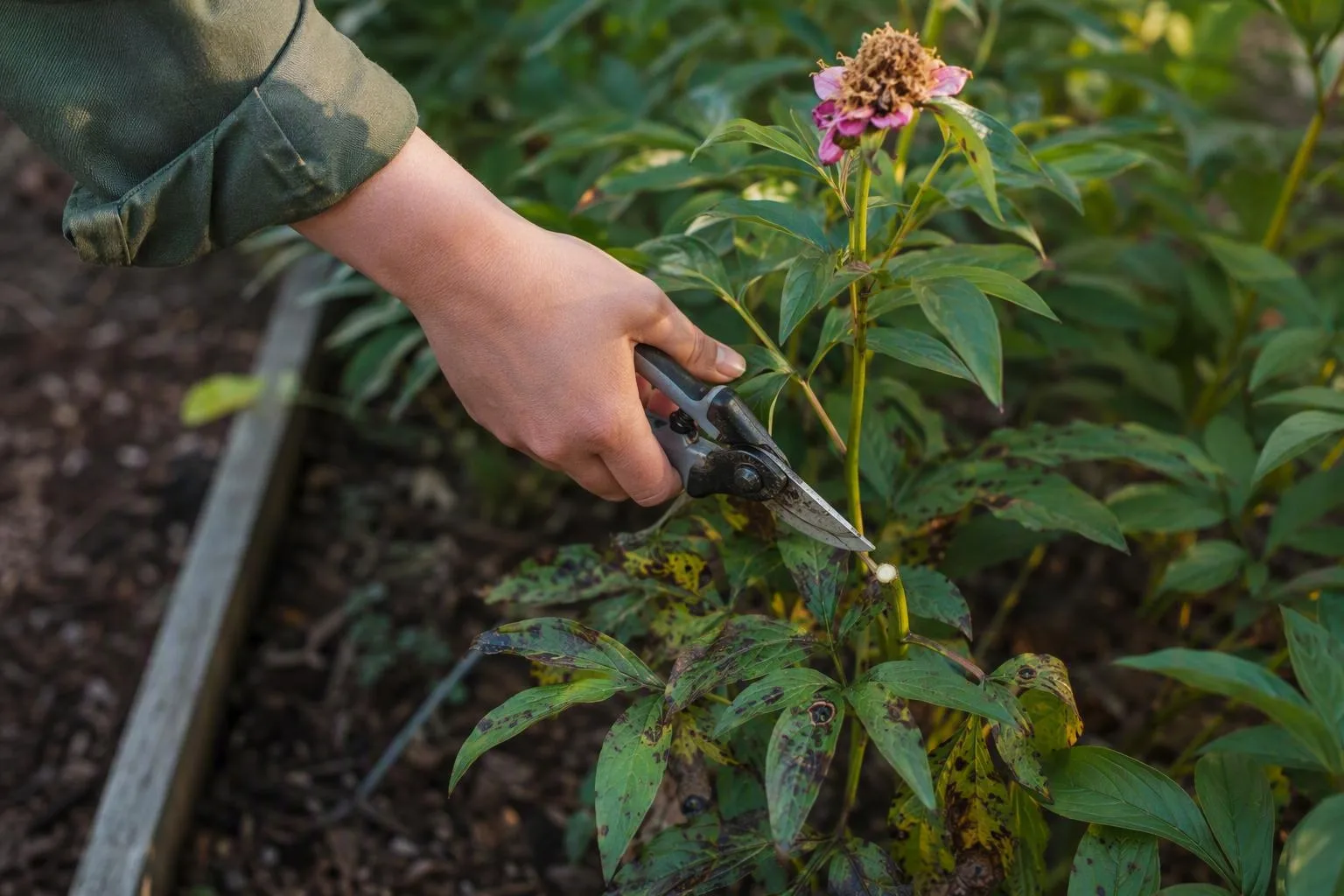
Three peony types, three end-of-season rules
The word “peony” hides three different growth habits. During flowering, all three benefit from removing ugly spent heads. After flowering, their stems must be read differently.
| Type | During flowering | After flowering |
|---|---|---|
| Herbaceous peony | Remove the faded flower and cut its stem to a healthy leaf set. | Keep green foliage through summer; remove the soft top growth only in the proper autumn cleanup window. |
| Intersectional or Itoh peony | Deadhead individual flowers in the same node-level way. | Keep leafy growth and any useful lower woody structure until late season; do not treat every brown-looking stem as disposable. |
| Tree peony | Remove the spent flower and seed pod without cutting into the woody framework. | Preserve the permanent woody branches unless there is a specific structural or damage-related reason to prune them. |
Herbaceous peonies die back to the crown rather than maintaining a permanent framework of branches. Their post-bloom leaves are the engine room for the rest of the growing season. The flower stalk can be removed, but the leafy plant should remain intact until autumn conditions make the foliage yellow, collapse, or become clearly finished. For the separate question of timing that final cut, use the guidance in When to cut back herbaceous peonies in autumn.
Intersectional, or Itoh, peonies sit between those habits. They produce substantial soft growth but can also retain short, woody-looking basal stems. Deadhead the flower stems while the plant is in bloom, then resist the urge to level the clump immediately afterward. A late-season inspection is more reliable: remove clearly dead or diseased material, but leave sound structure until you can see what is genuinely alive and what is only carrying old flower stalks.
Tree peonies are woody shrubs. A spent bloom can be followed down to its supporting stem and removed, but the cut should not become an excuse to shorten the branch below the flower. If you cut a tree peony's framework as though it were a herbaceous mound, you may remove the structure that carries future shoots and flowers. Tree peony pruning is a structural decision, not routine deadheading.
This distinction also explains why advice that says “cut peonies to the ground after flowering” is misleading. It may describe an eventual autumn task for an herbaceous type, but it is the wrong immediate instruction for a tree peony and an unnecessarily blunt one for an Itoh.
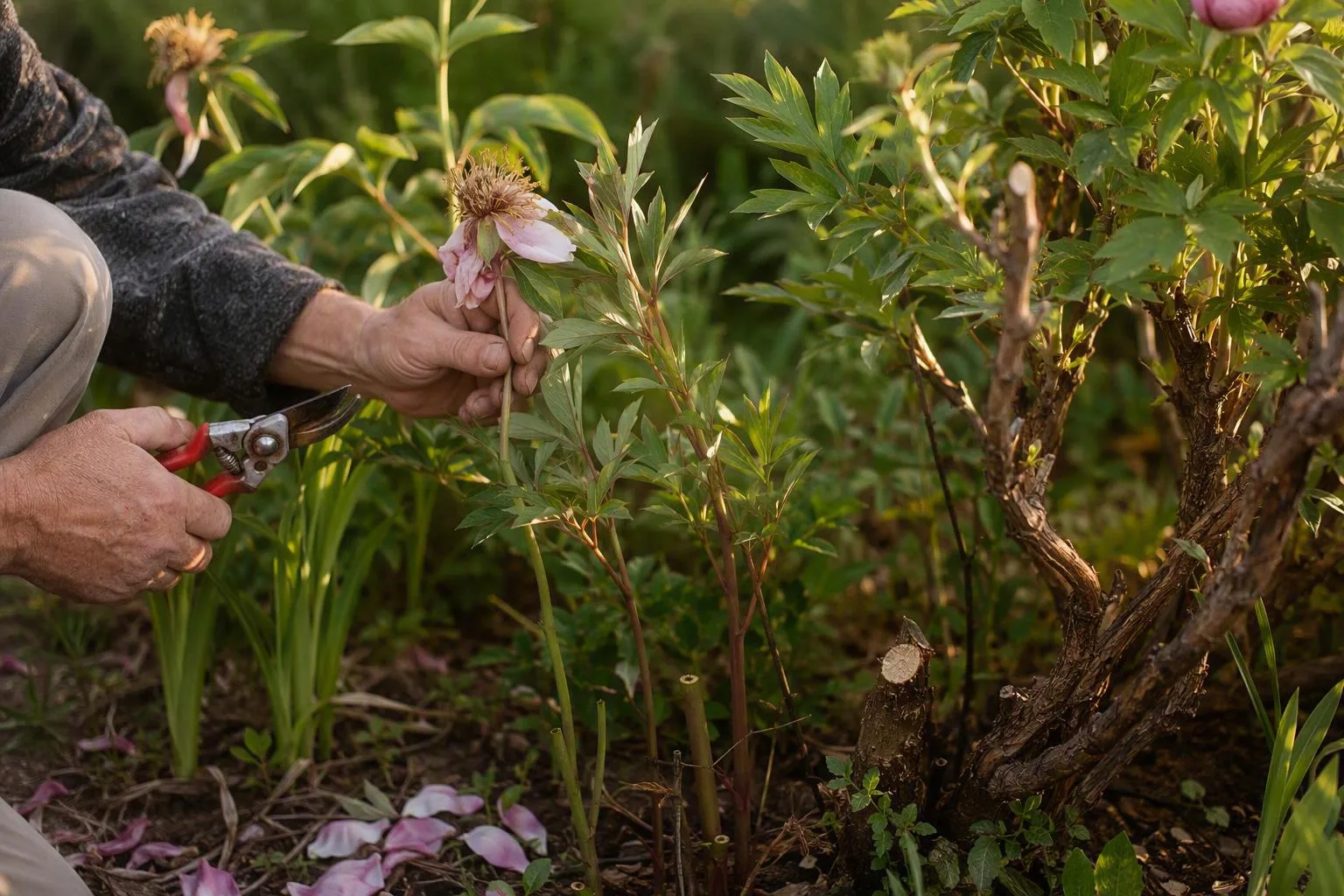
When to stop deadheading: the last flower is not the same as the last leaf
Continue removing spent flowers while the plant is flowering and the fading heads are spoiling the display. Stop when the flowering period has finished, or earlier if you deliberately want to leave some seed heads for their form or for wildlife interest. The stopping point is about flower-head removal, not about removing the green canopy.
Separate these three decisions:
- Stop deadheading: leave the remaining flower heads because the show is over or you have chosen to keep them.
- Remove seed heads: cut off pods that you do not want, while preserving the leaves beneath them.
- Cut back foliage: wait for the herbaceous plant to enter its autumn decline rather than treating post-bloom tidiness as permission to strip it.
Herbaceous peonies are not a repeat-flowering crop under ordinary garden conditions. If a second set of blooms appears, it is more likely to be an unusual response, a different plant type, or a mistaken identification than a dependable result of deadheading. Itoh and tree peonies still should not be promised a second flush simply because their spent flowers were removed.
What deadheading changes—and what it cannot change
After flowering, the plant has several competing jobs. Leaves continue to photosynthesize; the crown maintains existing tissues and prepares dormant buds; a fertilised flower can begin developing a seed pod. Deadheading removes that last sink before it has progressed very far. The leaves and crown remain, so the plant can continue its normal seasonal work.
That is the useful biological case for removing seed heads. It is also why the common claim that deadheading “puts all the energy into next year's flowers” is too tidy. The plant does not have a single energy bucket labelled flowers. Resources are distributed among leaves, stems, roots, crown buds, maintenance, and, where present, seeds.
My practical rule is to remove a seed head when it is unwanted, rather than performing increasingly hard cuts to chase a theoretical saving. A pod has little useful photosynthetic area of its own and must be supplied by the surrounding plant. From that, the reasonable deduction is that removing a pod can avoid some demand on nearby leaves and stem tissue. The size of that saving depends on whether the pod was fertilised, how long it remained, and how much foliage the plant has. It is not a measured promise that removing one pod feeds an exact number of leaves or buds.
Deadheading also cannot correct the main causes of a disappointing flowering season. A peony planted too deeply may produce leaves but few flowers; heavy shade can limit the resources available for flowering; a young division may need time to establish; and crown damage or poor drainage can weaken the plant. Removing spent heads after the fact does not reverse any of those conditions. For a structured diagnosis, see Why peonies fail to bloom: planting depth, shade, and crown age.
Nor should deadheading be confused with support. A flower head bent over by rain may need a ring, discreet stake, or a tie placed before the next storm. Cutting the stem after it has flopped is cosmetic rather than preventive. The better intervention is covered in How to support peonies before heavy rain without damaging stems.
Here is the counter-intuitive part: the more aggressively you tidy immediately after bloom, the less useful leaf area you leave for the crown. A peony that looks “clean” in June may be storing less than one that still looks slightly shaggy in July. I would rather tolerate a few old leaves and short stems than sacrifice the canopy for a display that lasts a week.
A five-minute cleanup that avoids next year's common failures
Work through the plant one stem at a time. That sounds slower than grabbing shears and levelling the mound, but it prevents the two mistakes that matter most: cutting healthy leaves and confusing disease with normal senescence.
- Find the finished flower. Look for browned petals, a collapsed bloom, or a green swelling beneath the old petals. Follow that flower's own stem; do not assume the nearest stem belongs to it.
- Trace downward. Locate the first healthy leaf set. If the leaves are spotted, soft, or dead, continue to the next sound set.
- Cut above the node. Remove the flower, pod, and bare stalk while leaving the chosen leaf pair attached. Do not cut through the node itself.
- Collect debris. Pick up fallen petals and detached pods, especially when foliage is already marked or the bed has stayed wet.
- Inspect before doing more. Once the heads are gone, stop. The remaining green plant is not unfinished deadheading; it is the part still doing useful work.
If the foliage is grey, brown-spotted, or covered with a soft decay, do not solve the problem by stripping every leaf on sight. First separate normal ageing from active disease. Look at whether spots are expanding, whether stems are collapsing, and whether grey mould is present around flowers or leaves. The visual comparison in Peony leaf spot and botrytis: how to tell them apart and manage affected foliage is more useful than treating every blemish as the same disorder.
When rain has bent a stem but the leaves are green, deadheading that flower may remove the worst weight, but it will not straighten the remaining stem. Support the plant if more weather is coming. If a stem is broken, remove it cleanly rather than leaving a torn wound that catches against neighbouring leaves.
If the whole clump was cut too hard after flowering, do not try to compensate with extra fertiliser or more pruning. There is no leaf canopy left for a quick cosmetic fix. Keep the crown watered during genuinely dry conditions, avoid creating a permanently wet root zone, and wait for new growth or the next season to show how much reserve remained. That is a projected outcome, not a guarantee; crown age, weather, and the extent of the cut all matter.
For a typical herbaceous peony, the next decision is not another cut. Watch the foliage through summer. Remove only clearly diseased or broken material as needed, then wait for the proper autumn window before taking down the remaining soft stems. For an Itoh or tree peony, wait even longer and assess the structure itself. Deadheading ends when the flowers end; the plant's season does not.