Grafting Techniques for Fruit Trees: Match the Cut to the Season
Choose the graft from the tree’s condition, not from a favourite technique. Dormant, pencil-thick wood points to whip-and-tongue grafting; a thick branch with bark that lifts points to bark grafting; actively growing summer stock with limited scionwood points to budding. The cut matters, but the real job is keeping compatible cambium pressed together, moist, and still long enough to form a living bridge.
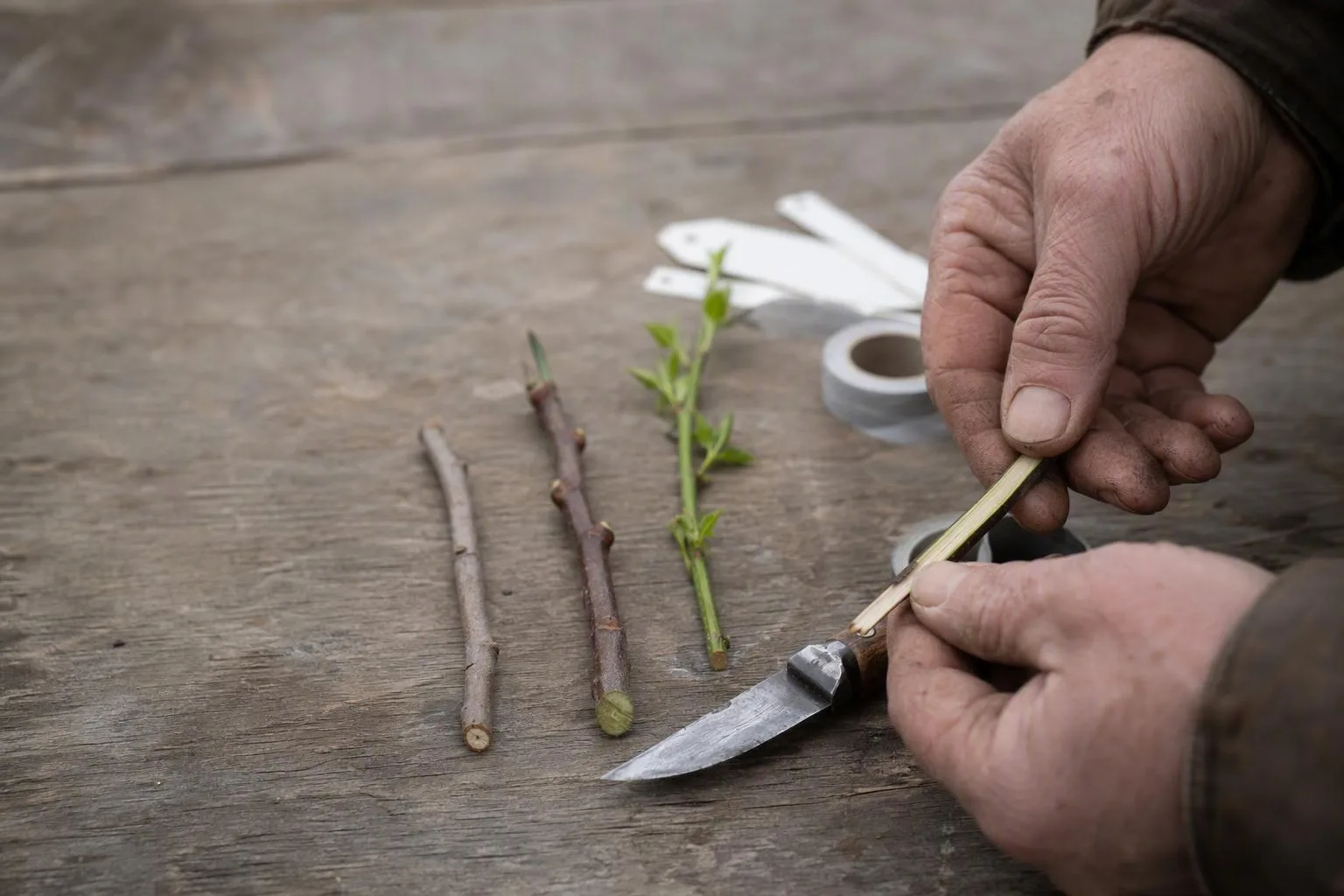
Start with the season: match the cut to sap movement
The simplest seasonal rule is this: use dormant scionwood before strong spring growth, bark grafting as the stock begins active growth, and budding during the summer growth window. That sequence follows what the plant is doing. A dormant scion has stored reserves but little immediate water demand. A growing rootstock can supply moisture and begin producing callus around the wound.
In late winter, whip-and-tongue grafting is the precise choice for similarly sized young stems. Cleft grafting is more forgiving of diameter differences and suits a dormant branch or trunk. Once the rootstock is pushing strongly, bark grafting becomes possible because the bark can separate from the wood without tearing the cambial zone. Later, chip budding or T-budding lets you use one mature bud instead of carrying an entire length of scionwood.
That is the practical answer to when to graft fruit trees: match the method to dormancy, sap movement, and stem size. A neat cut made in the wrong physiological window is still a poorly timed graft.
The four variables that decide whether a graft takes
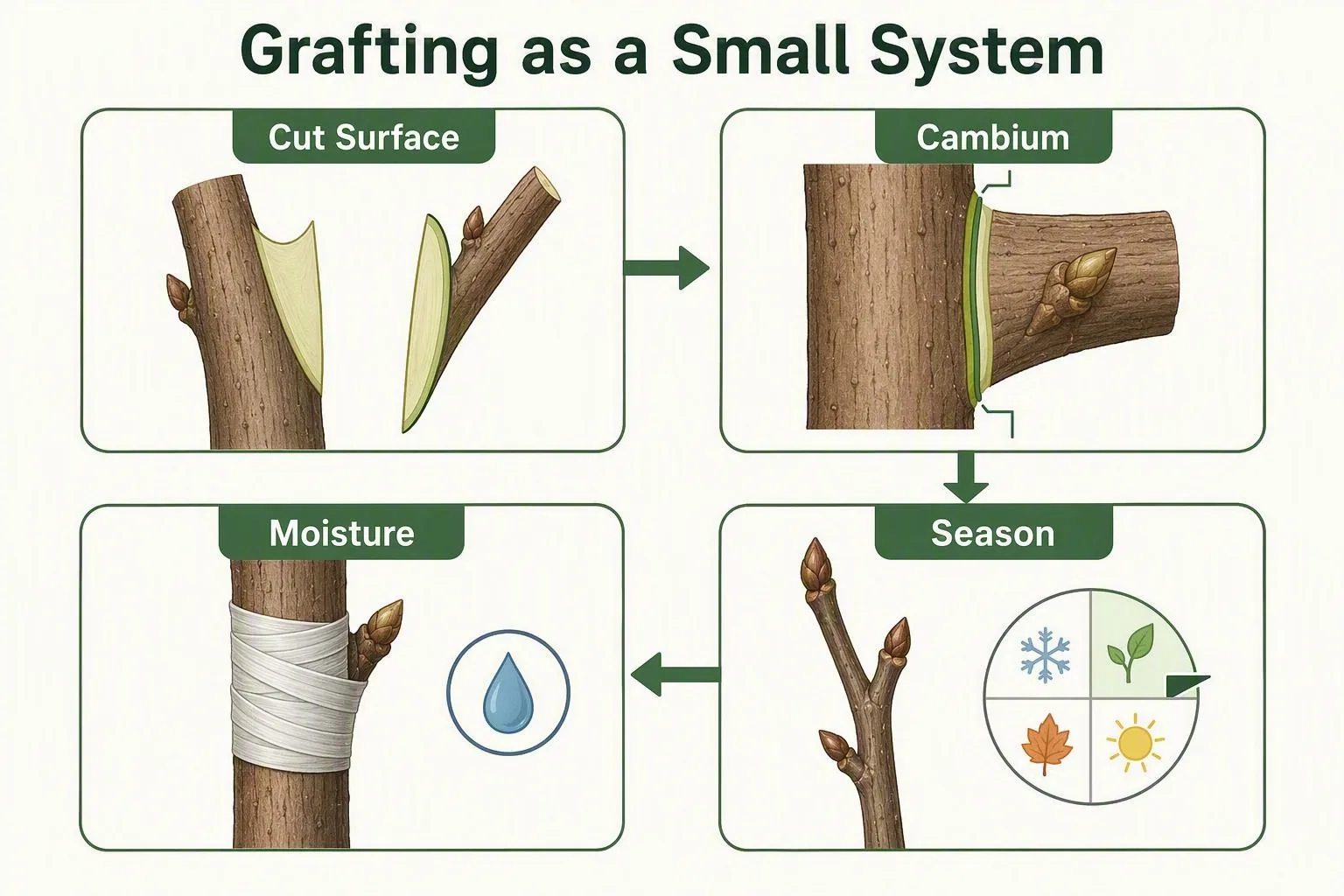
Grafting works as a small physical system. Four conditions have to cooperate:
- Cambium contact: the thin growth layer beneath the bark must meet on at least one side of the scion and stock. Matching the outer bark is not enough.
- Compatibility: the tissues must be capable of forming a durable union. Closely related combinations are the sensible starting point; unusual pairings should be treated as experiments, not dependable shortcuts.
- Suitable callusing conditions: the cut surfaces need temperatures that support new tissue without being driven into rapid drying or soft decay.
- Moisture and stillness: exposed wood must not desiccate, and the scion must not rock while the first callus bridge is forming.
A failed graft therefore needs diagnosis rather than immediate repetition. Brown, dry cut faces suggest exposure or poor sealing. A scion that remains green but separates after a windy spell points more toward movement. A union that appears to knit but later declines can involve weak alignment, delayed incompatibility, or a problem below the graft such as root damage.
Species, weather, knife control, scion freshness, and the condition of the rootstock all shift the result. Treat any quoted success expectation as local to a method, plant, and operator. The useful question is not “Which technique has the highest rate?” but “Which failure can I control most easily on this tree?”
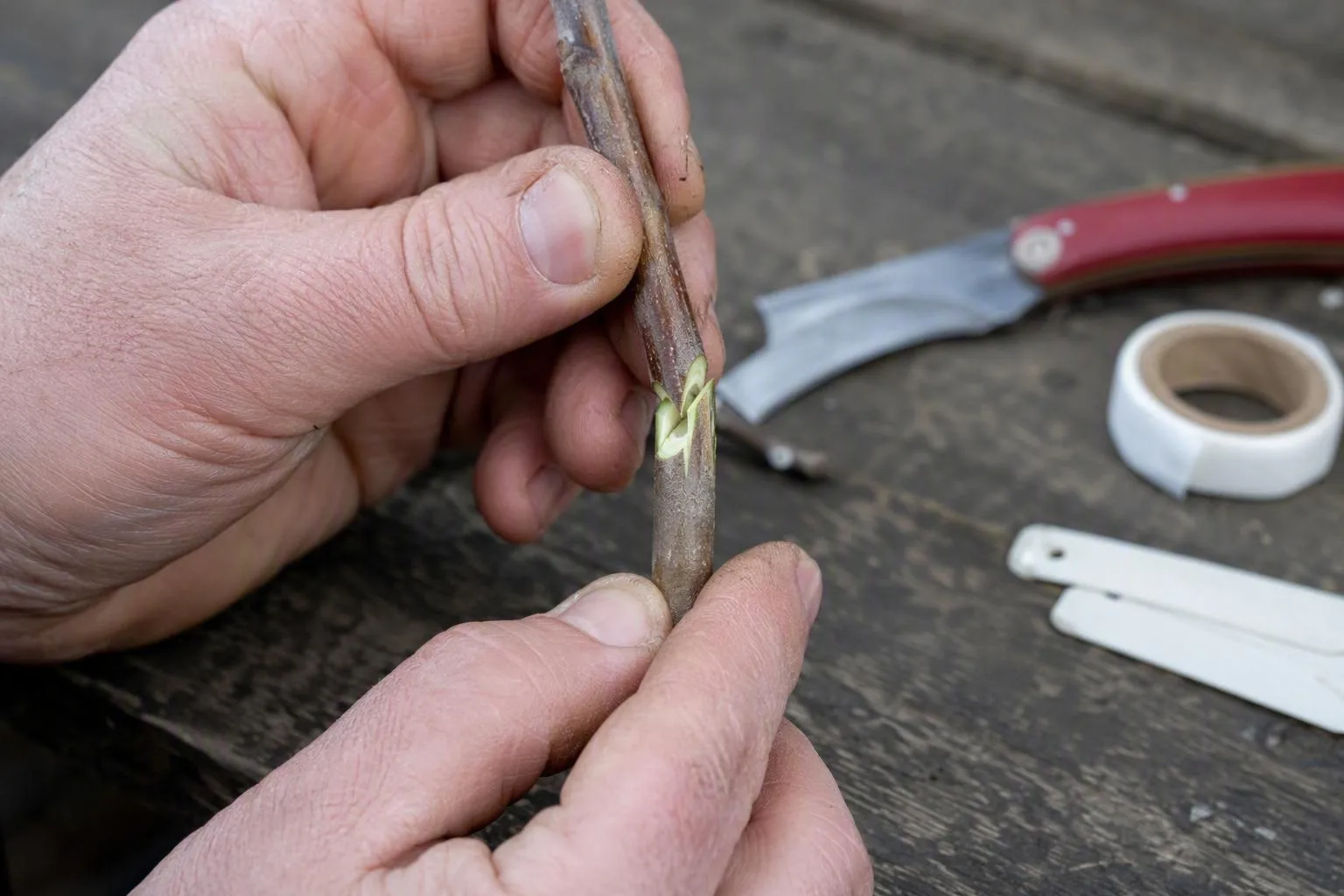
Late winter: whip-and-tongue for matching young wood
Whip-and-tongue grafting suits a young rootstock and scion close in diameter, often around pencil thickness. Both pieces should be dormant, firm, and free from shrivelling. The timing is usually late winter or very early spring, before the stock has made a flush of soft growth. In mild climates that may be earlier; in colder areas the work may be done indoors as a bench graft while outdoor trees remain dormant.
Start with a clean, sloping cut several times longer than the stem’s diameter. The surface should be flat rather than scalloped. Make a second, shorter cut down into each sloping face to create the tongue. The two tongues interlock, which gives the pieces more resistance to sliding than a simple whip cut.
Here is a worked example. Take an apple rootstock measuring 9 mm across and a dormant apple scion of similar size with three healthy buds. On the stock, make one long diagonal cut; its fresh face should be pale and even, not torn. Add the downward tongue roughly through the middle of that face. Prepare the scion with the matching diagonal and an upward tongue. When the pieces meet, the tongues should seat without forcing them sideways. If the diameters are not identical, line up one cambial edge precisely rather than centring the bark.
After alignment, tie the union firmly with grafting rubber or suitable tape. Seal any exposed cut surface above the top bud and around the join so it cannot lose water. The scion should remain in its original orientation; reversing it is an easy mistake when several pieces are being prepared at once. Label the variety immediately.
The method rewards accuracy but punishes hesitation. A blunt knife compresses the cambium, repeated trimming creates a stepped surface, and a loose tie lets the tongues separate. My judgement is that whip-and-tongue is the best learning method for a small batch of matching young trees, but not the best rescue method for a large established branch. That job belongs to a cleft or bark graft.
When diameters disagree, switch to a cleft graft
Cleft grafting handles a smaller dormant scion on a much larger branch or trunk. It is useful for changing a variety on an established apple or pear, or for adding a pollinising variety to a tree that already has a substantial framework. The tradeoff is a wider wound and a greater need for later support.
Make the cleft during the dormant season, using a sound branch that is not already weakened by canker, decay, or severe drought. Saw the branch cleanly, then split the cut end with a grafting knife or cleft tool. Prepare one or two scions with long, even wedges. The outer side of each wedge should carry the cambium that will meet the stock.
Insert the scions near the edge of the cleft, not in the centre of the large branch. That is where their cambium can align. If two scions are used, place them on opposite sides. Tie or bind the split so the scions cannot lift, then seal every exposed surface. As new shoots develop, remove growth below the graft and retain only the scion shoots you intend to train.
Cleft grafting can accommodate a larger diameter mismatch than whip-and-tongue, but it does not make alignment optional. It also creates a mechanical weak point. A long new shoot catches wind and can lever the scion out before the union has strengthened, so stake or tie the new growth to the branch framework. Leave the graft unsupported and a promising first season can end with a torn union.
Spring bark grafting works only after the bark releases
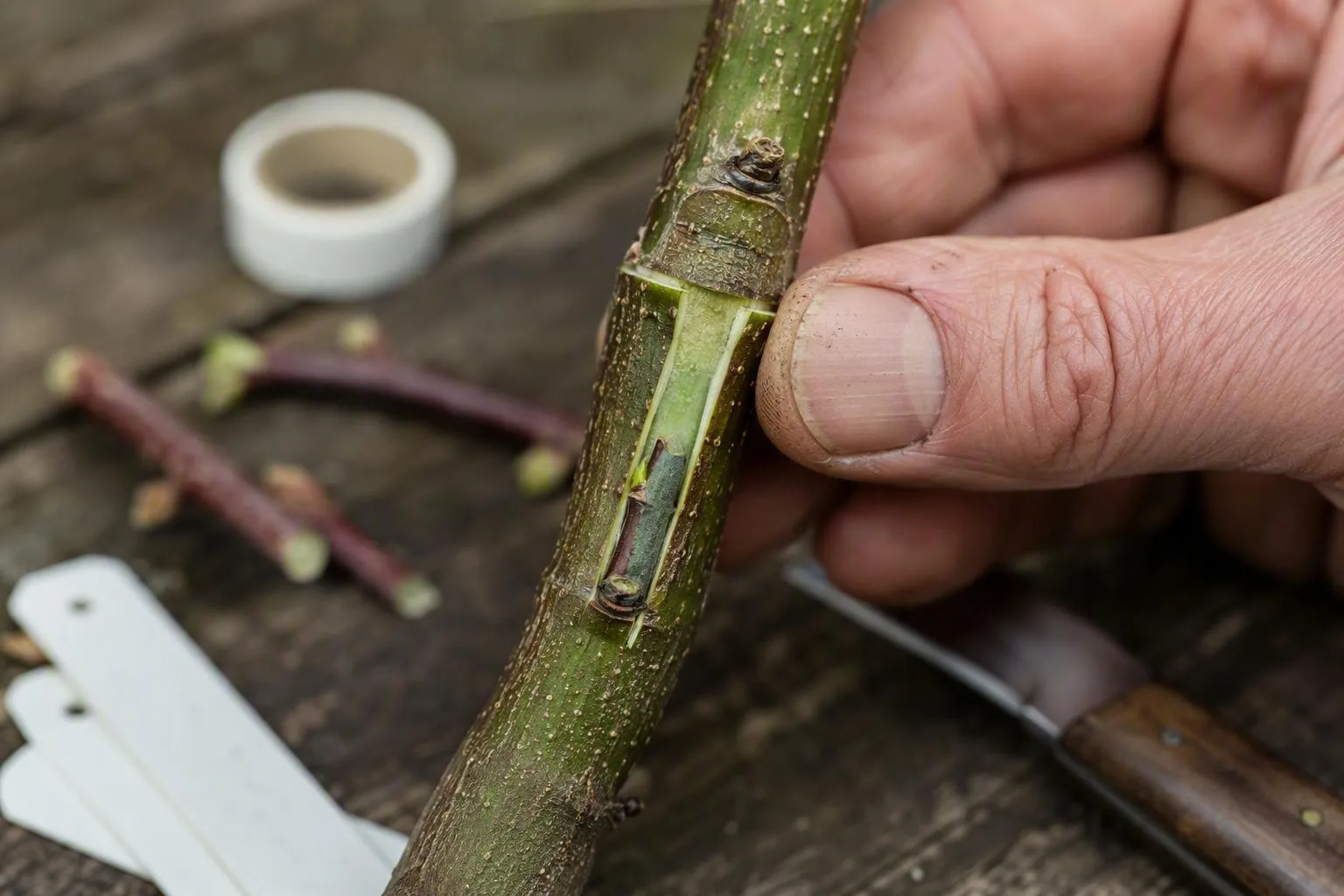
Bark grafting belongs later than a dormant cleft graft. The rootstock must be actively moving sap, while the scion is preferably still dormant or only beginning to wake. Test the stock by making a small shallow cut and trying to lift the bark. If it peels in a clean strip, the window is open; if it splinters or clings tightly, wait rather than forcing the knife.
Temperature is not the sole trigger. Strong root activity, adequate soil moisture, a healthy branch, and a scion that has not dried out all affect whether the bark lifts cleanly. A warm afternoon on a drought-stressed tree can give a misleading result: the bark may loosen unevenly while the tissue underneath is already under water stress.
Prepare the scion with a long, shallow bevel and a short shoulder at the top if the method calls for one. Slide the prepared face under the lifted bark, keeping the cambial edge aligned with the stock. On a broad stub, several scions may be placed around the circumference so more than one has a chance to establish. Secure each one, then seal the cut top and exposed edges.
As shoots grow, remove surplus shoots gradually rather than stripping the branch in one operation. The retained shoot becomes the new leader or framework branch; competing shoots consume the same water and stored carbohydrate while the graft is still vulnerable.
Summer budding is the efficient choice when scionwood is scarce
Chip budding and T-budding each use a single vegetative bud. That makes them economical when a desirable variety is represented by only a short length of fresh growth. The rootstock should be actively growing, and the budwood should be mature enough that the bud is plump and well formed but not dried or fully dormant.
Chip budding removes a small shield or chip of bark and wood containing the bud, then seats it into a matching recess in the stock. It does not depend as heavily on bark slipping, so it can be useful when the stock is growing but the bark will not lift cleanly. T-budding places the bud beneath two flaps of bark and is suitable when the bark separates readily.
For either method, cut the budwood shortly before use or keep it cool and wrapped so it does not lose moisture. Select a bud from a healthy, current-season shoot. Avoid flower buds: they may look impressive but do not provide the vegetative shoot needed to build the new branch.
After tying, check the bud by appearance and attachment rather than by a rigid calendar. A healthy bud remains plump and retains its characteristic green or brown colour; a dead one darkens, shrivels, or slips out with the surrounding bark. If the bud is still firmly attached when the stock has continued growing, that supports the judgement that the union is alive, though a living bud may still fail to push later.
Once a T-budded or chip-budded bud is clearly established, cut back the rootstock above it in stages or at the appropriate training point. Do not remove every competing shoot too early if the stock needs foliage to keep its roots supplied. Hot, dry weather quietly reduces the margin for error, so irrigate the stock beforehand if the soil is dry and work during a period when the bud will not immediately bake.
A season-by-season grafting calendar for apples, pears, plums, and cherries
Use the plant’s condition as the calendar. Dates shift with climate, elevation, spring warmth, and whether the material is being bench grafted indoors.
| Seasonal condition | Useful method | Best fit | Main risk |
|---|---|---|---|
| Dormant stock and dormant scion | Whip-and-tongue | Young, similar-sized stems | Drying or inaccurate cambium alignment |
| Dormant stock with a large branch | Cleft graft | Variety changes on established trees | Large wound and wind breakage |
| Rootstock actively pushing and bark lifting | Bark graft | Large spring stubs | Torn bark or dehydrated scion |
| Actively growing stock with mature budwood | Chip budding or T-budding | Limited scionwood | Immature buds, heat, or poor attachment |
Apples and pears are generally the easier starting point for home grafting because many commonly grown combinations are familiar and widely propagated. Plums and cherries need more careful attention to timing, freshness, and disease management; a method that behaves well on an apple should not be assumed to behave identically on a stone fruit.
Collect dormant scionwood from healthy, correctly labelled growth and store it cool and slightly moist, not wet. The practical details belong in a separate guide to how to collect and store dormant scionwood for spring grafting. Record variety, date, and tree source on the bundle before it enters storage. A lost label can turn a technically successful graft into a permanent mystery.
For dates and regional storage advice, compare your plan with University extension guidance on fruit tree grafting and budding windows. Treat that advice as a regional starting point, then watch the stock itself. Calendar dates cannot tell you whether bark will lift on a particular tree that week.
The aftercare period is part of the graft, not an afterthought
Sealing and tying do not finish the job. Inspect the union for drying, movement, mould, and swelling. A bud or scion that stays green is encouraging, but it is not proof of a strong union. A weak union may carry leaves briefly and then split under wind or the weight of new growth.
Remove shoots emerging below the graft because they belong to the rootstock and can outgrow the new variety. At the same time, avoid removing useful foliage above the union before the scion has enough growth to support itself. Support long shoots early, especially after a cleft or bark graft.
Binding removal is conditional: loosen or remove the tie as soon as the union is held firmly and the material begins to press into expanding bark. Stretching rubber may accommodate growth for a while; non-stretch tape deserves closer inspection. Do not wait for a fixed date if the stem is swelling, because the mark left by a constricting tie can remain after the graft succeeds.
Keep a failure log. Write down the tree and variety, rootstock or branch diameter, method, date, weather, scion condition, sealant, and what the union looked like when it failed. Compare that record with how to identify a healthy graft union and diagnose failure. The pattern usually points to one controllable weakness: drying, movement, a poor cut, unsuitable timing, or a pairing that should not have been trusted.
Use a sharp, clean tool and disinfect it between suspect or diseased trees. This is especially important when working on edible fruit trees: clean tools reduce the chance of moving pathogens, but they do not sterilise infected wood or make diseased scionwood safe to propagate.
Choose the technique by the job, not by the name on the label
Start with three observations: identify the fruit tree, measure the rootstock or branch, and test whether the bark is tight or actively slipping. Then choose:
- Matching young stems and dormant material: whip-and-tongue.
- A smaller scion on a larger dormant branch: cleft grafting.
- A large spring stub with bark that lifts cleanly: bark grafting.
- One scarce bud on actively growing stock: chip budding or T-budding.
Rootstock choice still matters after the technique is settled. The guide to rootstock selection for dwarf, semi-dwarf, and standard fruit trees is the place to check the eventual tree size, anchorage, and soil fit. After the union takes, use a deliberate plan for pruning newly grafted fruit trees during the first three years; early cuts determine whether the graft becomes a leader, a side branch, or an awkward fork.
The useful rule to save is this: the cut is only half the graft; the season supplies the other half. If the first attempt fails, do not simply repeat the same technique. Ask what the tree was doing, whether one cambial edge truly met, whether the surfaces dried, whether the union moved, and whether the pairing was sound. Your next decision is not yet “which knife cut?” It is “what condition is the stock in today?”
Three side decisions that prevent avoidable losses
Can an apple scion go on a pear rootstock?
Apple and pear are related pome fruits, but related does not mean universally compatible. Some combinations may form a union that grows briefly and then weakens, while others may fail to unite at all. Use a documented, known-compatible pairing for dependable work. Treat an unusual cross-genera combination as a trial, label it clearly, and do not use it as the foundation of a small orchard.
How long should grafting tape or rubber ties stay on?
Inspect the union instead of choosing one fixed removal date. If the binding is cutting into swelling bark, loosen or remove it. If the union still shifts when the new shoot is gently supported, replace the support without allowing the tie to constrict the stem. The material matters, but the tree’s expansion is the decision signal.
Should every graft be coated with wax?
Use a suitable sealant where the method leaves exposed wood and where drying is a realistic risk. Wax or grafting compound cannot repair a misaligned cambium, a loose scion, or a graft made outside its useful physiological window. Sealant protects a good join; it does not create one.
For broader compatibility questions, consult horticultural references on graft compatibility among apple, pear, plum, cherry, and related fruit trees before treating a novel pairing as reliable.
Frequently Asked Questions
Can I graft an apple scion onto a pear rootstock?
Explain that both are pome fruits but compatibility is not guaranteed across genera; recommend using known-compatible rootstock and scion combinations, and treat unusual pairings as experimental rather than dependable.
How long should grafting tape or rubber ties stay on a fruit tree graft?
Give a conditional answer based on active growth and union strength rather than one fixed date: inspect regularly, remove or loosen before constriction, and distinguish biodegradable grafting rubber from non-stretch tape.
Should I use grafting wax on every fruit tree graft?
Explain that the purpose is to prevent drying at exposed cuts; use an appropriate sealant on methods with exposed wood, but avoid relying on wax to compensate for poor cambium alignment, loose tying, or unsuitable timing.